⚠️ Spoiler Warning: This article contains spoilers
Today I want to talk about one of writers’ favorite tools: the plot twist.
Because a good plot twist is not just about shocking the audience.
The best twists make you look back and think:
“Of course. The clues were there all along. I just didn’t see them.”
A twist should surprise you, but it should also feel inevitable once the truth is revealed.
And that brings me to The Housemaid (Directed by Paul Feig, 2025).
I went to see the movie with my cousins, and I walked in with pretty high expectations. One of them is a huge fan of the books, and she was genuinely worried that the movie would ruin the story.
Surprisingly, it didn’t.
The adaptation stayed very loyal to the original plot, which is always a big achievement when a book is turned into a movie.
She also kept telling me:
“There’s a crazy twist. The wildest twist I’ve ever read.”
So naturally, I sat down expecting to be completely shocked.
And I really enjoyed the movie.
But was the twist actually surprising?
For an experienced viewer…
Not really.
I guessed the direction of the ending within the first thirty minutes.
And that is what I want to talk about today: how plot twists work, and why some of them become easier to predict depending on how the story presents its clues.
The Movie Reveals the Truth Earlier Than It Thinks
From the beginning, the movie gives us hints that the father is the real problem.
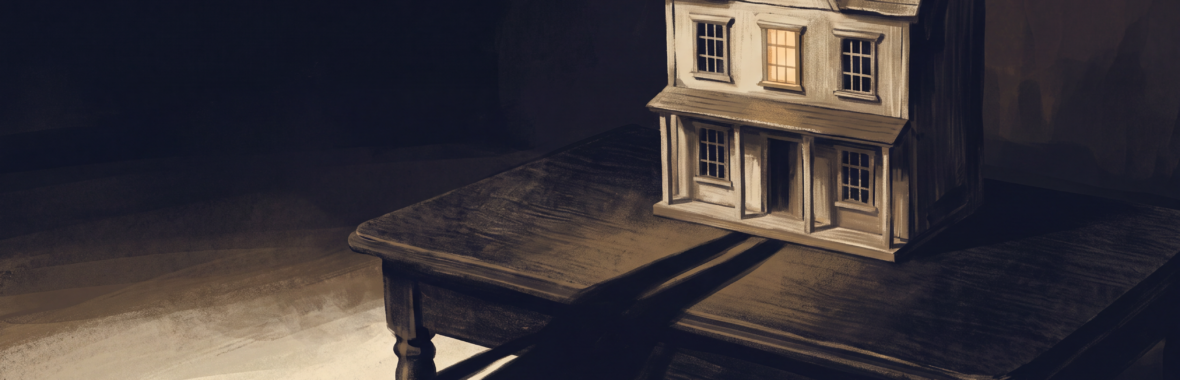
One of the strongest examples is the dollhouse.
The little girl uses the dolls to represent the real family, and the doll that says “privilege” is the one representing the father.
Earlier in the movie, the girl said the exact same thing at the dinner table — which tells us she’s repeating his words.
That small detail tells us something important:
She is not just acting strangely.
She is reflecting the environment she grew up in.
The movie is already showing us who has the real influence in the family.
If she seemed strange or unpleasant at first, it reflects directly on him.
Red Flags, Distractions, and How Thrillers Manipulate Us
One of the most common tricks in thrillers is using obvious red flags as a distraction.
When a character is presented as extremely suspicious, dangerous, or unstable, the audience naturally focuses on them.
And sometimes that is exactly what the writers want.
Unlike children’s stories, where good and evil are usually clearly separated, thrillers play with our expectations.
They show us something dramatic and encourage us to follow the obvious path.
The interesting question becomes:
Are we noticing the truth?
Or are we simply following the clues the writer wants us to notice?
And honestly, there is something very satisfying about seeing the “perfect” character hiding something dark.
In many dramas, characters who seem almost too good to be true rarely stay angelic .
Either they’re too good for their own safety, or they’re hiding something terrible.
The Clues That Made the Twist Easier to Predict
The first major clue was Nina.
From the very beginning, she is presented as unstable.
She loses control quickly.
Then we learn about her mental health history, her medication, her hospitalization, and the incident involving her daughter.
Those are a lot of warning signs placed on one character.
And in storytelling, when one character carries that many obvious signs, I usually start asking:
“Is this really the villain, or is this the distraction?”
Because the movie is almost telling us too loudly where to look.
Then there is Millie.
The moment we learn that she has a criminal record, I immediately understood that she was not going to remain completely innocent.
The question was not whether she would cross a line.
The question was how far she would go.
The movie gives us enough information to understand that both women are hiding something.
A Twist Doesn’t Always Need To Be Impossible To Guess
But here is the thing:
A predictable twist does not automatically mean a bad story.
There are different types of twists.
Some twists are designed to make you say:
“I never saw that coming.”
Others are designed to make you say:
“I can’t believe I missed all those clues.”
The second type can still work beautifully.
The problem is that The Housemaid relies heavily on surprise, and for viewers who recognize thriller patterns, the mystery becomes easier to solve.
The movie is not hiding the information.
It is simply making the clues easier to connect.
Final Thoughts
So, was The Housemaid a bad movie because I guessed the ending?
No.
I actually enjoyed watching it.
And this is the important part: different viewers experience twists differently.
My cousin, who never read the books, had no idea what was coming.
My aunt was completely shocked.
And that is the nature of mysteries — the experience depends on what patterns you recognize and how closely you follow the details.
A great plot twist is not only about hiding information from the audience.
It is about controlling what they notice.
And for me, The Housemaid revealed its hand a little too early.
But even when you know where the story is going, the journey can still be entertaining.


Leave a Reply