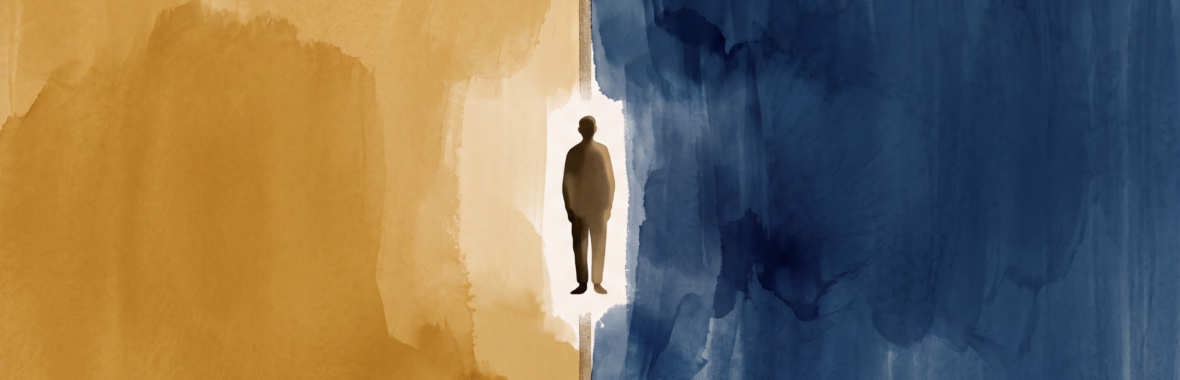
Since the war began, I’ve noticed something that keeps coming back, especially when I look at celebrities, influencers, and people with large public platforms.
There seems to be an increasing pressure to choose a side.
Not just to have an opinion, but to declare it. To explain it. To post it. To put a flag in the background. To make sure everyone knows where you stand.
And sometimes I find myself wondering: When did having an opinion become something we are expected to perform?
I understand why people feel the need to speak. When something deeply affects people, silence can feel impossible. And for people with large platforms, speaking publicly can bring attention to issues that might otherwise receive less attention.
But there is another side to this.
Why do we sometimes feel that we have to choose a side in every conflict, even when we don’t fully understand it? Why does saying “I don’t know enough” seem less acceptable than immediately declaring a position?
Maybe part of the answer is that war makes the world feel much simpler than it actually is.
When people are surrounded by fear, grief, anger, and uncertainty, gray areas become difficult to hold. The world starts to look like two teams: us and them, good and bad, right and wrong.
Choosing a side gives us something solid to stand on.
And social media can make that pressure even stronger. When people believe their opinion is unpopular, they may become less willing to express it publicly. At the same time, online platforms make political expression highly visible, which can create the feeling that everyone else has already chosen their position.
So remaining undecided can start to look suspicious.
Silence can be interpreted as a statement.
And a statement can be interpreted as a declaration of identity.
That is where I think something interesting happens.
Sometimes, it feels as though we aren’t really choosing between realities. We’re choosing between narratives.
Most people experience wars and international conflicts through screens. They see videos, photographs, interviews, headlines, posts, speeches, and personal stories. They encounter individual experiences that may be completely real and deeply painful, but they rarely experience the entire reality themselves.
So they build a picture from what reaches them.
And once they connect emotionally to a particular story, it can become very easy to identify with it.
Maybe they recognize themselves in the story of people who feel attacked.
Maybe they identify with people who feel oppressed.
Maybe they recognize the story of people fighting for survival, freedom, justice, security, or belonging.
The details of a conflict can be complicated, but the human stories inside it are often easier to understand.
And sometimes, I wonder whether that is what we are actually choosing.
Not necessarily a complete understanding of the conflict, but a narrative that feels familiar to us.
There is nothing inherently wrong with responding emotionally to human suffering. In fact, empathy often begins exactly there.
But there is a difference between feeling for people and believing that we therefore understand everything happening around them.
I also wonder what happens when taking a political position becomes part of someone’s identity.
Once an opinion becomes part of who we are, disagreement can stop feeling like disagreement with an idea. It can start feeling like disagreement with us.
And then changing our minds becomes much harder.
Because changing your mind no longer means:
“I learned something new.”
It can feel like:
“I was wrong about who I am.”
Maybe that is why people sometimes hold onto positions even when they are still learning. Admitting uncertainty can feel like weakness, while certainty gives us a sense of belonging.
And belonging is powerful.
Especially online.
There is also something particular about celebrities.
A famous actor, singer, or influencer has something most of us don’t: an enormous audience. When they speak, their words can travel much further than ours. Their involvement can bring attention to an issue and encourage people to learn more about it.
But having a large audience doesn’t automatically mean having a complete understanding of a complicated political conflict.
And I don’t think celebrities are uniquely guilty of this. They are simply more visible.
The same pressure exists among ordinary people.
We are constantly being asked, directly or indirectly:
What do you think?
Whose side are you on?
What do you support?
What do you condemn?
And sometimes the expected answer seems to be immediate and absolute.
There doesn’t seem to be much room for:
“I’m still thinking.”
“I don’t know the whole story.”
“I understand why these people are hurting, but I don’t understand the entire conflict.”
“I disagree with you, but I don’t hate you.”
Or simply:
“I don’t know.”
I think we sometimes underestimate how difficult it is to genuinely say those words.
Especially in a world where opinions can become social identities.
There is another thing that makes me uncomfortable: the moment when a position starts to feel less like conviction and more like affiliation.
When everyone around you is saying the same thing, posting the same symbols, using the same phrases, and sharing the same images, it becomes difficult to tell where personal conviction ends and social belonging begins.
That doesn’t mean every public expression is fake.
It doesn’t mean everyone who posts about a political issue is doing it for attention.
And it certainly doesn’t mean that caring about a cause is merely a trend.
But I think it is worth asking ourselves a quieter question:
Why am I saying this?
Because I believe it?
Because I understand it?
Because I want other people to know where I stand?
Because I am afraid of what they will think if I remain silent?
Because everyone around me is saying it?
Or because I genuinely feel that I have something meaningful to contribute?
Maybe sometimes the answer is more than one of these.
And maybe that’s okay.
I don’t think the solution is for everyone to stop speaking.
I don’t think silence is automatically wiser than taking a position.
And I don’t think being uncertain means that we should stop caring.
What I do think is that there should be room between silence and certainty.
Room to think.
Room to listen.
Room to change our minds.
Room to care about human beings without pretending we understand every political detail.
Room to criticize something without hating the people involved.
Room to disagree without immediately turning the disagreement into a battle over identity.
And perhaps most importantly, room to admit that we don’t know.
Because maybe the real problem isn’t that people choose sides.
Maybe it is that we have started believing that we must always prove which side we belong to.
So I keep coming back to the same question:
Can we still have an opinion without turning it into a flag?
Can we care without turning that care into an identity?
Can we listen to a story without immediately deciding that we know the entire story?
And, in a world that constantly asks us to declare ourselves, can we still be comfortable saying:
“I’m thinking.”

Leave a Reply